CLARE – A living song of thanksgiving
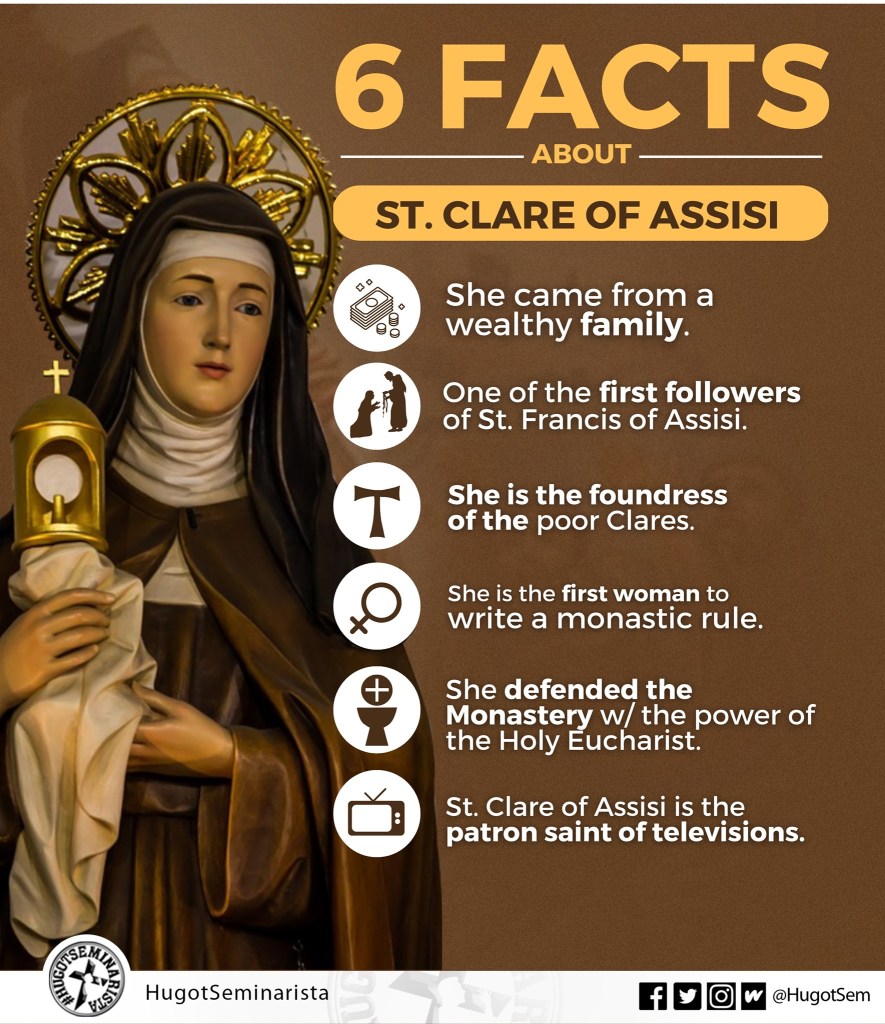
St. Clare of Assisi was co-foundress of the Order of Poor Ladies, or known today as the Poor Clares, and first Abbess of San Damiano; born at Assisi, 16 July, 1194; died there 11 August, 1253. She was the eldest daughter of Favorone Scifi, Count of Sasso-Rosso, the wealthy representative of an ancient Roman family, who owned a large palace in Assisi and a castle on the slope of Mount Subasio. Such at least is the traditional account. Her mother, Ortolana, belonged to the noble family of Fiumi and was conspicuous for her zeal and piety. From her earliest years Clare seems to have been endowed with the rarest virtues. As a child she was most devoted to prayer and to practices of mortification, and as she passed into girlhood her distaste for the world and her yearning for a more spiritual life increased. She was eighteen years of age when St. Francis came to preach the lenten course in the church of San Giorgio at Assisi. The inspired words of the Poverello kindled a flame in the heart of Clare; she sought him out secretly and begged him to help her that she too might live “after the manner of the holy Gospel”. St. Francis, who at once recognized in Clare one of those chosen souls destined by God for great things, and who also, doubtless, foresaw that many would follow her example, promised to assist her. On Palm Sunday Clare, arrayed in all her finery, attended high Mass at the cathedral, but when the others pressed forward to the altar-rail to receive a branch of palm, she remained in her place as if rapt in a dream. All eyes were upon the young girl as the bishop descended from the sanctuary and placed the palm in her hand. That was the last time the world beheld Clare. On the night of the same day she secretly left her father’s house, by St. Francis’s advice and, accompanied another companion, proceeded to the humble chapel of the Porziuncula, where St. Francis and his disciples met her with lights in their hands. Clare then laid aside her rich dress, and St. Francis, having cut off her hair, clothed her in a rough tunic and a thick veil, and in this way the young heroine vowed herself to the service of Jesus Christ.. From that moment onward she lived a life of prayer, totally devoted to God who had loved her totally.
Her spirituality had often been limitedly understood to be an outdated and medieval way of life that doesn’t find its significant relation to the world of today. Yes, the world of today. Our world had drastically changed over the years. Some changes had been for the better but some are even worsening the already chaotic state of humankind. St. Clare too, lived in a time where there were changes happening in her midst. But how did she deal with all these?
Looking closely at the person of Clare would help us catch a glimpse of the beauty of God in her soul. In her writings she often refers to God as “our benefactor, the Father of Mercies”. For her, just like St. Francis, everything is a gift, an overflow of God’s goodness and love. What we have and continue to receive from Him, is not something we deserve, but something freely given to us. And the natural response to a free gift is gratitude. That is basically what Clare’s life is – a song of thanksgiving to God!
In our experience, the depth of our gratitude depends on the greatness of the giver and the affection that comes with it. Oftentimes, the gift is not of so much value, but the giver means a lot to us, and so the gift becomes priceless. God is within us, . His gift is the life within us, the breath we take in everyday that makes us alive. This truth is the basis of Clare’s life, her vocation, her prayer. In her simple method of contemplation, she divided them into four ways: gaze upon Him; consider Him; contemplate Him; desire to imitate Him.
Gaze upon Him. In St. Clare’s life she gazed on God through the example of St. Francis. She was able to see the face of God in the very person of Francis- “alter Christus”, the other Christ. And as she gazed intently on Him, she was drawn more intimately to follow Him. She “gazed with heart and soul at Someone with the intention of being touched. This gazing is the fruit of longing to imitate Him, which was already alive in her soul”(Light Shining through a Veil).
In our prayer, gazing can be spending time before the Blessed Sacrament, intently and lovingly staring at Him in His Eucharistic presence. In this stage what is ask of us, is – time! We have to go out of our busy schedule and make space for God. Only then can we experience the “gazing” that led Clare to “love Him totally who gave Himself totally for us”. Most of us get too fidgety about time. Sitting or kneeling idly before the Blessed Sacrament can be considered a fruitless activity. Sometimes we rate productivity with action and concrete outcome of our labors. But with God, as experienced by St. Clare, real productivity is when we can put down all our defenses and stop from “doing” and just “be”. In our everyday life, do we take time to pause and just feel the breeze? When we eat, are we really aware of the food we eat or we just gulp down whatever it is? If we become aware of these simple ordinary things around us, then we can be open to the mystery and wonder that God creates for us everyday, every minute that pass.
Consider Him. Clare allowed herself to be drawn to Him. There in the silence of the cloister, having left everything to live for God alone and possessing only one love, Clare spent her life in intimacy with the one she loved. The bull of canonization testifies that “she would assiduously spend the greater part of the day and night in watching and in prayer” (BullCan 16). Knowing Christ, her one love, stirred in her heart the deep love for Him.
As we move from just “gazing” in our prayer to “considering”, we can implore the Holy Spirit, the spouse of our souls, to bestow on us the gift of Knowledge. To know Christ in our hearts is the first step to be able to love Him in our soul. This is where the rudiments of our religion will be of valuable help. But the ultimate way is to know ourselves in the light of our faith. Who am I? Who is God for me? These similar questions were asked by St. Francis himself when he first heard the call to conversion. Who am I? This can lead to varying and complicated responses, with the aid of other forms of personality and psychological processing we can more or less have a glimpse of the reality within us. But the eternal truth remains the same: we are the sons and daughters of God! If we live by this truth we can be assured of peace that only comes from Him.
Who is God? n our Franciscan tradition, God is a Father. For St. Francis, He is “our Father in heaven”. In the book The Journey and the Dream by Murray Bodo, he described how Francis saw God. “To Francis everything in him and around him was a gift from his Father in heaven. He expected nothing, so he was grateful for everything. Even a piece of earth was a cause for rejoicing, and he thanked God always for everything that was. He held everything to his heart with the enthusiasm of a child surprised by some unexpected toy. The air he breathed, the sounds he heard, the sights and smells of all the world entered his grateful soul through senses perfected by gratitude and purity of heart.“
For St. Clare, God the Father is our “benefactor, the Father of mercies”. He is our protector, our provider, our consolation, our security and our refuge. She identifies more closely to the second person of the Trinity, Jesus Christ, whom she described as “the God who was placed poor in the crib, lived poor in the world, and remained naked on the cross”. Knowing Christ so intimately, Clare cannot help but love Him totally. She answered Love for love.
Contemplate Him . Having known God in a deeper level, moves us to commit ourselves to Him. St. Clare in her third letter to St. Agnes of Prague, encouraged her (and us) to : Place your mind before the mirror of eternity! Place your soul in the brilliance of glory! Place your heart in the figure of the divine substance! And transform your entire being into the image Of the Godhead Itself through contemplation.
Contemplation in Clare’s mind is to be totally absorbed in God. It is like a drop of water falling into the ocean. As long as it remains apart from the larger body of water, its just a drop of water. But once it falls, it unites, then it becomes the ocean. This can also be best described in the gospel of John, Chapter 15- ” I am the Vine, you are the branches. Those who abide in Me and I in them bear much fruit, because apart from ME, you can do nothing”. Contemplation is being aware that God is in us, that ” in Him we move and have our being”. As we breathe, eat, rest, work and pray, He is present to us more than we to ourselves. So we just have to take some moments of quiet where we can be present and aware of this wonderful reality that lies hidden to those who are so caught up in the world. Making it a habit to spend five to ten minutes of quiet at the start of the day and before retiring, would help us sharpen our sense of awareness to the present moment where God is always alive!
Desire to imitate Him “For just as the body without the spirit is dead, so faith without works is also dead”(James 3:26). Our love can only be whole once it is shared and given. Clare like Francis has the deep desire for the mission. In her second letter she exhorted St. Agnes in these words : If you suffer with Him, you will reign with Him.
If you weep with Him, you shall rejoice with Him;
If you die with Him on the cross of tribulation,
you shall possess heavenly mansions in the splendor of the saints and
in the Book of Life, your name shall be called glorious among men”.
Jesus in the last supper gave His disciples a new commandment. ” I give you a new commandment, that you love one another. Just as I have loved you, you also should love one another. By this everyone will know that you are my disciples, if you have love for one anothers (John 14:34-35)
In this world we are His hands by which He will touch the hearts of the lonely and oppressed, bring healing to the sick; we are His voice to proclaim the Kingdom, to comfort the sorrowful, to give advice to the lost; we are His feet to go to the farthest corners of the world to bring His love, to lead others to the Way, to carry the burdened and dying; we are his eyes to direct the way to others, to help them see the wonders of creation; we are His heart to love, to forgive, to console and give hope to His flock.
May we, in our weakness and frailty, be like St. Clare a living song of gratitude to God who created us. That in our thanksgiving we may be able to inspire others to see the wonders and marvels that God in His mercy has done in our midst. And when sister Death comes, we too, may be able to say; ” Go forth my soul without anxiety, for you have a good escort for your journey, for He who created you has made you holy” (St. Clare).